



UOSD PRECLINICAL MODELS AND NEW THERAPEUTIC AGENTS
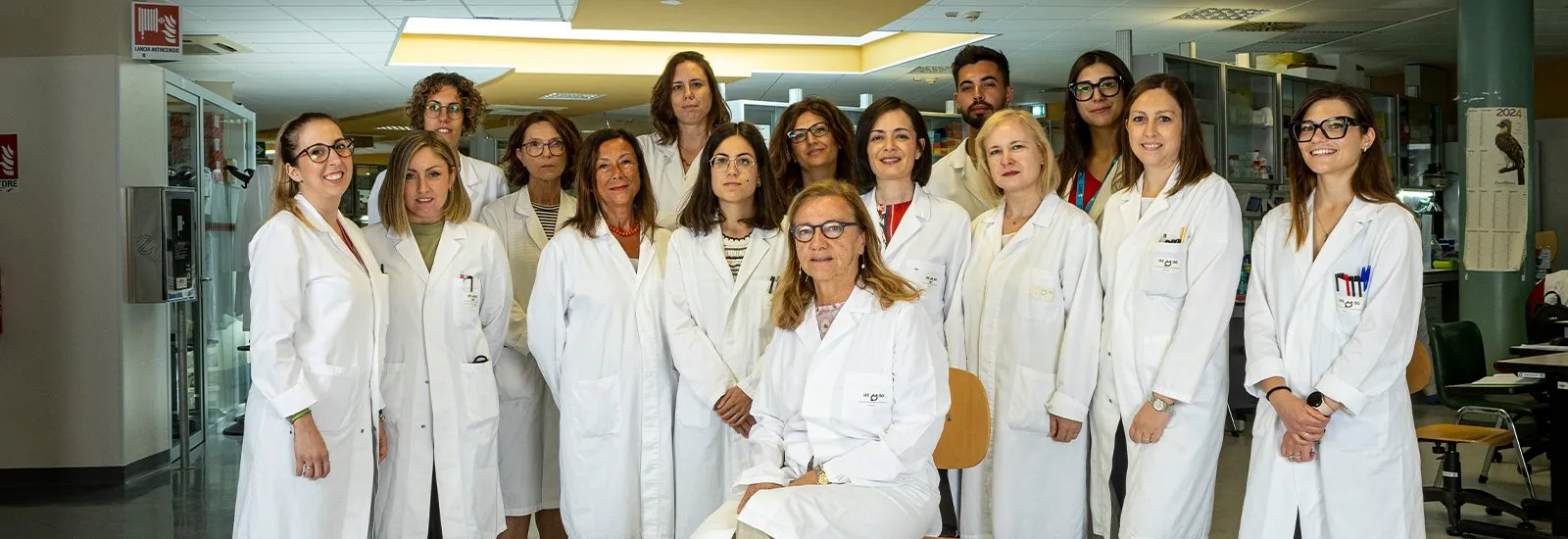
- Chiara Bazzichetto
- Gaia Barocci
- Matteo Brignone
- Valentina Caprara
- Fabiana Conciatori
- Claudia Contadini
- Simona D’Aguanno
- Marica Di Caprio
- Marta Di Martile
- Adriana Maria Di Stefano
- Donatella Del Bufalo
- Rossella Galati
- Giulia Gentile
- Barbara Nuvoli
- Adele Petricca
- Celia Roman de la Calle
- Rosanna Sestito
- Piera Tocci
- Elisabetta Valentini
1. Mission
Acquisition of drug resistance limits the efficacy of cancer treatments and accounts for therapeutic failure in most patients. Tumor evolution and the coexistence of multiple resistance mechanisms make these cases particularly difficult to treat. Instead of addressing resistance only after it emerges, a promising strategy is to prevent it by targeting the early adaptive processes that enable tumor cells to survive therapeutic stress. These non-genetic, reversible adaptations play a pivotal role in tumor relapse and treatment failure.
The Unit aims to identify and characterize the molecular determinants of these adaptive mechanisms in relevant preclinical models, including patient-derived xenografts and organoid/tumoroid systems of ovarian, lung, and colon cancers, melanoma, and mesothelioma. Within these models, the Unit investigates critical signaling pathways—such as endothelin-1, estrogen, and Bcl2/Bcl-xL—that regulate cell plasticity and the dynamic interactions between tumor cells and the tumor microenvironment (TME). Cellular plasticity enables tumor cells to activate finely tuned adaptive programs under therapeutic pressure, ensuring survival and evasion from treatment.
Our research seeks to decipher how cancer cells develop dependencies on essential survival signals, the disruption of which can block malignant interactions and open new therapeutic opportunities. These adaptive dependencies may occur within the same signaling cascade, among parallel compensatory pathways, or through functional cooperation across distinct networks. Recent advances in understanding these interdependencies—together with insights into tumor–stroma interactions and the broader tumor ecosystem—have laid the groundwork for the rational design of combined treatment regimens.
The Unit leverages advanced 3D technologies to generate patient-derived preclinical models—such as spheroids, organoids, and tumoroids—that self-organize into organotypic cultures embedded in tunable 3D matrices. These models faithfully retain the genetic landscape and drug responsiveness of the original tumors, offering a robust platform to explore actionable vulnerabilities and optimize combinatorial regimens.
Ultimately, the Unit’s goal is to characterize the molecular networks that govern drug response and resistance, enabling the discovery of pharmacologically actionable pathways and predictive models of treatment efficacy. Future directions include the integration of artificial intelligence and computational modeling to simulate cell–cell interactions driving cancer progression and therapeutic tolerance. The Unit is committed to advancing patient-centered translational research, fostering interdisciplinary collaborations, and engaging patient advocates to transform the clinical management of solid tumors.
2. Research activities
Resilience to anticancer drugs often involves a complex interplay of selection and adaptation, including variations in the tumor microenvironment (TME) and in the composition and stiffness of the extracellular matrix (ECM). Therefore, novel strategies to overcome the diverse and complex resistance mechanisms require a comprehensive understanding of the underlying dynamics.
Dr. Bagnato’s group employs innovative technologies and patient-relevant tumor models with the potential to bridge the gap between fundamental research on the mechanisms and timing of drug resistance and clinical applications, translating these findings into actionable strategies to extend therapeutic efficacy. Drug-induced adaptability is shaped by intricate feedforward loops (FFLs) among tumor cells, the surrounding TME, and the host ecosystem.
The findings highlight key mechanisms underlying the acquisition of drug unresponsiveness in ovarian cancer and explore modeling strategies that capture transcriptional plasticity. These mechanisms enable cells to adapt to therapeutic stress by transiently activating alternative survival pathways through protein–protein interactions, including YAP/TEAD and/or ZEB. In particular, this research revealed the context-specific roles of the endothelin-1 (ET-1)/ET-1 receptor (ET-1R) axis and its integration with YAP signaling within the dynamic interactions between high-grade serous ovarian cancer (HG-SOC) cells and the TME. These interactions influence therapy response and support the development of ET-1R-based combinatorial therapeutic strategies with platinum-based therapy or PARP inhibitors (PARPi).
Preclinical models of ovarian cancer developed within this project are designed to investigate functional intercellular interactions. ET-1R blockade, which interrupts tumor–stroma communication, inhibits the therapeutic escape pathway of PARPi, sensitizing HG-SOC cells to olaparib by using clinically relevant patient-derived preclinical models, including patient-derived xenografts. These findings provide strong in vivo evidence that ET-1R antagonists—mimicking the effects of the anti-VEGF antibody bevacizumab by simultaneously suppressing YAP and other intertwined pathways—contribute to reducing the permissive TME and weakening the invadopodia machinery. The combination of ET-1-targeted therapeutics with PARPi thus represents a promising anti-metastatic strategy.
The identification of the ET-1 FFL as a tumor- and TME-associated actionable vulnerability indicates that ET-1R blockade, targeting both HG-SOC cells and the TME, may represent an effective therapeutic option for patients with HG-SOC. Since the TME continually evolves in response to tumor signals, cellular interactions, immune pressures, metabolic changes, and therapeutic interventions, these preclinical models are essential to elucidate the functional dynamics that drive the formation of metastatic niches. The results of this project provide insights into how the TME evolves during therapy and how specific stromal organizations promote ovarian cancer progression or resistance.
In collaboration with Prof. M. Loizidou (UCL, London, UK), the group developed HG-SOC patient-derived tumoroids—3D multicellular models engineered with a dense central artificial cancer mass containing HG-SOC cells embedded within a compressed hydrogel that recapitulates the stromal compartment, comprising type I collagen, laminin, fibronectin, and stromal cells. ET- 1-stimulated HG-SOC cells in the tumoroids displayed altered migration and formed cellular aggregates resembling micrometastases (invasive bodies) that invaded the stroma; these effects were reduced by treatment with a dual ET-1R antagonist.
This study establishes tumoroids with varied cellular compositions as a model suitable for mechanobiological research, allowing the investigation of matrix stiffness and TME interactions, and supporting drug screening to guide therapeutic decisions in HG-SOC. Moreover, these tumoroids serve as a platform to explore cellular interactions within the TME that contribute to drug resistanceand recurrence. Future research will incorporate advanced biomaterial-based ECM architectures and patient-mimetic 3D systems, enhancing tissue-realistic modeling for early-stage interventions through rationally designed, data-driven, and adaptive treatment strategies.
Dr. Bagnato’s group continues to train and mentor several researchers, supporting their growth toward scientific independence and integration within multidisciplinary teams involving national and international collaborators from diverse disciplines, including computational science, surgery, physics, oncology, and engineering.
This research is supported by AIRC and the Italian Ministry of Health. AIRC MFAG funds a five-year project led by Piera Tocci, while additional support comes from the Berlucchi Foundation (Rosanna Sestito) and IFO internal funding (P. Tocci and R. Sestito).
Inhibition of the antiapoptotic protein Bcl-2 has emerged as a highly effective treatment for several hematological malignancies. Global translational efforts exploring Bcl-2 inhibitor combinations are rapidly transforming clinical practice, leading to higher response rates, prolonged remissions, and improved overall survival.
Dr. Del Bufalo’s group investigates the mechanisms through which antiapoptotic proteins of the Bcl- 2 family influence melanoma progression and its crosstalk with the TME, particularly immune cells. The group demonstrated that Bcl-2 family inhibitors enhance the sensitivity of melanoma models to targeted therapy and extended these findings to other tumor histotypes, including colon cancer and glioblastoma.
Consistent with prior findings on Bcl-2, the team showed that Bcl-2-like protein 10 exerts pro-tumoral effects and that the melanoma-specific antiapoptotic protein Bcl-xL modulates macrophage recruitment and polarization, establishing a TME that favors tumor development. In collaboration with Sapienza University of Rome, new inhibitors of antiapoptotic proteins with significant antitumor activity were identified through machine-learning-based virtual screening. The group also demonstrated that Bcl-2 family inhibitors sensitize diverse cancer models to therapy and modulate key pathways involved in tumor progression, such as the Hippo pathway.
Given its expertise in melanoma biology and BH3 mimetics, the group published several reviews and special issues covering advances and novel treatment options in metastatic melanoma, hypoxia-regulated pathways, the role of pro-survival Bcl-2 family members as diagnostic and prognostic biomarkers, the involvement of semaphorins and their receptors in melanoma–hypoxia crosstalk, the contribution of Bcl-xL to melanoma pathobiology, and the immunomodulatory activities of phytochemicals. The use of BH3 mimetics in ovarian cancer was also explored.
Additional studies addressed the pathobiology and therapy response of gastrointestinal, lung, and head-and-neck cancers, as well as glioblastoma. Collaborations with Sapienza University demonstrated the antitumor effects of essential oils, inhibitors of epigenetic regulators, and muscarinic receptors, along with the regulation of specific microRNAs in leukemia models. Work with Chieti University led to the identification of allosteric kinesin inhibitors showing antitumoral efficacy in gastric adenocarcinoma models.
These studies were supported by AIRC through a research grant to Donatella Del Bufalo, by three-year AIRC fellowships in Italy awarded to Marta Di Martile, Martina Chiacchiarini, and Matteo Brignone, and by a two-year overseas fellowship to Anna Maria Lucianò. Additional support came from the Pezcoller Foundation (Fabiana Conciatori) and IFO internal funding to Chiara Bazzichetto, Fabiana Conciatori, Simona D’Aguanno, Marta Di Martile, and Elisabetta Valentini.
Malignant pleural mesothelioma (MPM) is a pleural tumor primarily caused by asbestos exposure, typically manifesting after a latency of 20–40 years and characterized by poor therapeutic response and a median survival of approximately 12 months. Significant efforts are therefore devoted to identifying sensitive biomarkers for monitoring at-risk individuals to enable early diagnosis and prompt therapeutic intervention.
Previous studies by Dr. Galati highlighted the role of 17β-estradiol in MPM pathogenesis, leading to the hypothesis that asbestos-induced inflammation in exposed subjects increases 17β-estradiol levels. To test this hypothesis, the group conducted a study assessing serum levels of 17β-estradiol and its metabolites in healthy subjects (both asbestos-exposed and unexposed) and in MPM patients.
The results showed higher 17β-estradiol levels in mesothelioma patients compared to healthy controls. Levels were similar among MPM patients with environmental or occupational exposure, but men occupationally exposed to asbestos displayed significantly higher 17β-estradiol levels than women. Additionally, the analysis of the DHEA-S/androstenedione/17β-estradiol score revealed increased values in asbestos-exposed individuals and MPM patients compared to unexposed subjects.
These findings support the use of 17β-estradiol, DHEA-S, and androstenedione as biomarkers for MPM risk assessment and early diagnosis in asbestos-exposed populations, potentially enabling timely intervention and improved patient care. The group continues to investigate the oncogenic role of 17β-estradiol in MPM, with the goal of identifying novel targets for antitumor therapy.