




UOSD CELLULAR NETWORKS AND MOLECULAR THERAPEUTIC TARGETS

STAFF
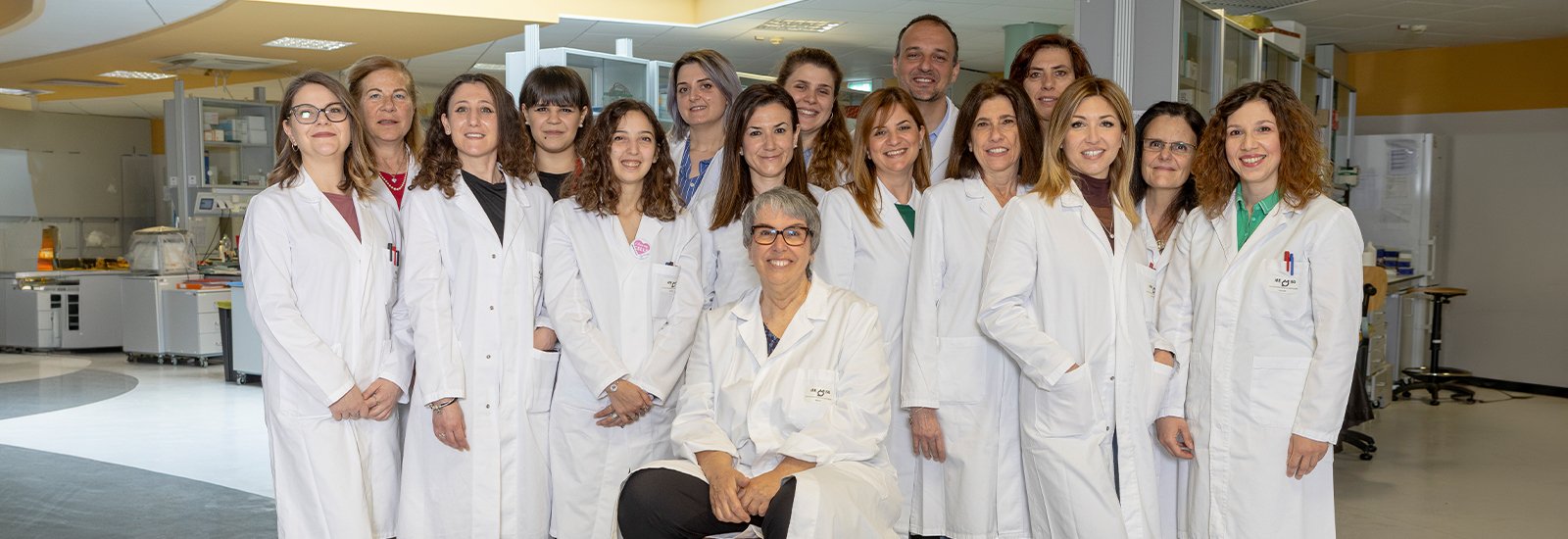
- Claudia Abbruzzese
- Giulia Bon
- Giuliana Di Rocco
- Gabriella D’Orazi
- Giulia Fanelli
- Giulia Federici
- Maria Pia Gentileschi
- Alessia Garufi
- Rossella Loria
- Klizia Maccaroni
- Laura Monteonofrio
- Marco Giorgio Paggi
- Dr Davide Valente
- Alessandra Verdina
- Ilaria Virdia
- Giulia Calconi
- Aurora Puce
- Silvia Sozzi
1. Mission
Cellular networks and novel therapeutic targets represent key areas of innovation in modern cancer therapy. The potential pathways for personalized interventions involve both oncogenic signaling cascades and the biochemical or genetic alterations that define cancer cells.
The mission of this Unit is to develop and sustain advanced expertise in these domains to elucidate the hierarchy of therapeutic targets and the molecular mechanisms underlying the pharmacological action of innovative therapies.
This Unit serves a dual function:
- On one hand, it supports researchers and clinicians in the design and implementation of preclinical and clinical studies, stimulating and assisting the development of research programs integrated into innovative investigator-driven clinical trials.
- On the other hand, it provides expertise to researchers engaged in the discovery and development of new biomarkers and therapeutic agents.
Additionally, a relevant part of the Unit’s activity is dedicated to drug repurposing, an emerging discipline that identifies novel applications for compounds already approved by regulatory agencies, even if originally developed for different pathological conditions
2. Research and clinical activities
The translational research objectives of the Unit “Cellular Networks and Molecular Therapeutic Targets” are pursued through the integrated work of staff researchers in collaboration with intra- and extra-mural partners.
This group focuses on drug repositioning in glioblastoma, an extremely aggressive tumor that remains largely refractory to conventional therapy. Their studies have demonstrated the efficacy of the neuroleptic drug chlorpromazine (CPZ) in inhibiting key functions of glioblastoma cells, providing the rationale for a Phase II multicenter clinical trial conducted in close collaboration with the Neuro-Oncology Unit. In this trial, CPZ has been added to the first-line therapy for patients with glioblastoma harboring an unmethylated MGMT promoter. By investigating CPZ’s modulation of GBM signal transduction and energy metabolism, the group identified its molecular target, pyruvate kinase M2 (PKM2)—a glycolytic enzyme central to GBM bioenergetics and the Warburg effect—representing a critical therapeutic vulnerability. This finding has opened the possibility to explore additional molecules capable of interfering with PKM2 oncogenic functions and disrupting tumor bioenergetic balance.
Dr. Bon investigates cross-resistance mechanisms among sequential cancer therapies. In collaboration with Dr. Loria and melanoma research groups, she identified a role for SEMA6A both as a mediator of response to combined dabrafenib–trametinib treatment and as a prognostic factor in BRAF-mutated metastatic melanoma. Mechanistically, the group discovered that a SEMA6A/RhoA/YAP axis mediates tumor–stroma interactions and limits tumor response to dual BRAF/MEK inhibition. In collaboration with the Phase IV Clinical Studies Unit and the Medical Oncology Unit, Dr. Bon has also identified DARPP-32 and t-DARPP proteins as potential predictive biomarkers of response to anti-HER2 agents in HER2-positive advanced breast cancer. Furthermore, in partnership with the Clinical Trial Center, she is investigating therapy resistance mechanisms in gastrointestinal and non–small cell lung cancers.
Dr. Loria explores molecular and immunogenic traits of osteosarcoma (OS) to develop novel therapeutic strategies. This project, supported by the “ALE CON NOI” Association, is conducted in collaboration with the Orthopedic Unit, the IRE Bio-Bank, and the Bioinformatics Unit. OS and normal bone specimens have been collected, and robust protocols have been established for RNA extraction from both tissues. Through RNA-seq analyses, the group identified transmembrane proteins with kinase activity involved in tumor–stroma interactions, selectively expressed in OS lesions. These findings open avenues to evaluate such proteins as new molecular therapeutic targets. For functional validation, Dr. Loria is developing three-dimensional (3D) models that replicate the unique bone stroma environment using advanced 3D bioprinting technology.
Together with the Unit’s head, Dr. Di Rocco investigates HIPK2 as a prognostic biomarker in colorectal cancer (CRC). HIPK2, a conserved kinase regulating diverse biological processes, has emerged as a fine-tuner of several signaling pathways frequently altered in CRC. In collaboration with the Pathology Unit and the Clinical Trial Center, Drs. Di Rocco, Virdia, and Verdina identified HIPK2 as a prognostic biomarker candidate and revealed a previously unrecognized functional link between HIPK2 and the KRAS pathway. Their studies showed that HIPK2 contributes to KRAS signaling activation by physically associating with active RAS complexes and sustaining the RAS/MAPK cascade, thereby promoting KRAS-mutant CRC growth. Moreover, HIPK2 was identified as a potential predictive marker of favorable response to adjuvant chemotherapy in stage II CRC.
Building on the discovery of HIPK2’s involvement in KRAS signaling, Dr. Valente, in collaboration with the SAFU, investigated the contribution of HIPK2 to KRAS-driven tumorigenesis using KRAS^G12D (KC) mice, a well-characterized model that recapitulates pancreatic cancer development from preneoplastic lesions to invasive carcinoma. The group demonstrated that both genetic and pharmacological inactivation of HIPK2 in KC mice attenuates oncogenic KRAS signaling and reduces pancreatic tumorigenesis. Interestingly, they observed marked differences in collagen fiber density and desmoplastic cell presence between HIPK2 wild-type and knockout mice. To overcome limitations of traditional 2D and 3D models, Dr. Maccaroni developed an ex vivo 3D model based on organotypic slice cultures derived from fresh pancreas, liver, and spleen samples. These slices, maintained in culture for up to one week, effectively recapitulate fibrosis induction. The team is now using this system to identify novel biomarkers of fibrosis and to test pharmacological compounds for potential antifibrotic therapies.
Building on the findings linking HIPK2 to CRC and pancreatic tumorigenesis, and considering the emerging role of circular RNAs (circRNAs) in disease and liquid biopsy, Dr. Monteonofrio is assessing the expression of circHIPK2 and circHIPK3 in frozen tumor tissues, matched normal samples, and plasma. She established a droplet digital PCR (ddPCR) assay to quantify circHIPK expression across cell models, tissues, and biological fluids. Transcriptomic analyses of circHIPK2-silenced cells revealed strong regulation of transmembrane and intracellular sugar and nucleotide transporters. In collaboration with the Endocrinology and Pathology Units and Prof. D’Orazi’s group, Dr. Monteonofrio is also generating a living biobank of organoids to dissect the transcriptomic landscape of gastro-entero-pancreatic neuroendocrine neoplasms (GEP-NEN).
Prof. D’Orazi’s group investigates the roles of endoplasmic reticulum stress, the unfolded protein response (UPR), and autophagy in determining cancer cell sensitivity to chemotherapy. Preclinical experiments employ conventional drugs (e.g., doxorubicin, cisplatin, PARP inhibitors) as well as natural compounds such as zinc–curcumin. The group’s main objective is to inhibit mutant p53 and reactivate wild-type p53. In collaboration with the Endocrinology Unit and Dr. Monteonofrio, Prof. D’Orazi’s team conducts functional studies on GEP-NEN in vitro models to identify and validate novel therapeutic approaches for this rare tumor type.
In collaboration with the Radiology Unit of ISG and the Medical Physics Unit of IRE, Dr. Verdina investigates the potential risk of low-dose ionizing radiation exposure from diagnostic radiology and nuclear medicine procedures. Using double immunostaining for 53BP1 and γH2AX, her group first demonstrated in cultured non-tumor cells that repeated CT scans over short intervals induce cumulative DNA damage. The study is now extending ex vivo to peripheral blood mononuclear cells from cancer patients undergoing serial CT scans every three months for therapy monitoring.
The Unit’s head has developed a functional assay based on p53 mitotic centrosomal localization (p53-MCL) in peripheral blood mononuclear cells to improve classification of pathogenic ATM variants. Building on these results, Dr. Federici, together with the Unit’s head, has launched two main projects. The first, in collaboration with the Departments of Human Neuroscience at Sapienza University of Rome and Carlo Bo University of Urbino, applies the p53- MCL test to assess ATM variants in patients with atypical, mild forms of Ataxia-Telangiectasia. The second project focuses on the genetic validation of p53-MCL for ATM variant classification in cancer predisposition, employing CRISPR/Cas9 to generate knock-in cell clones each carrying specific ATM variants.


